

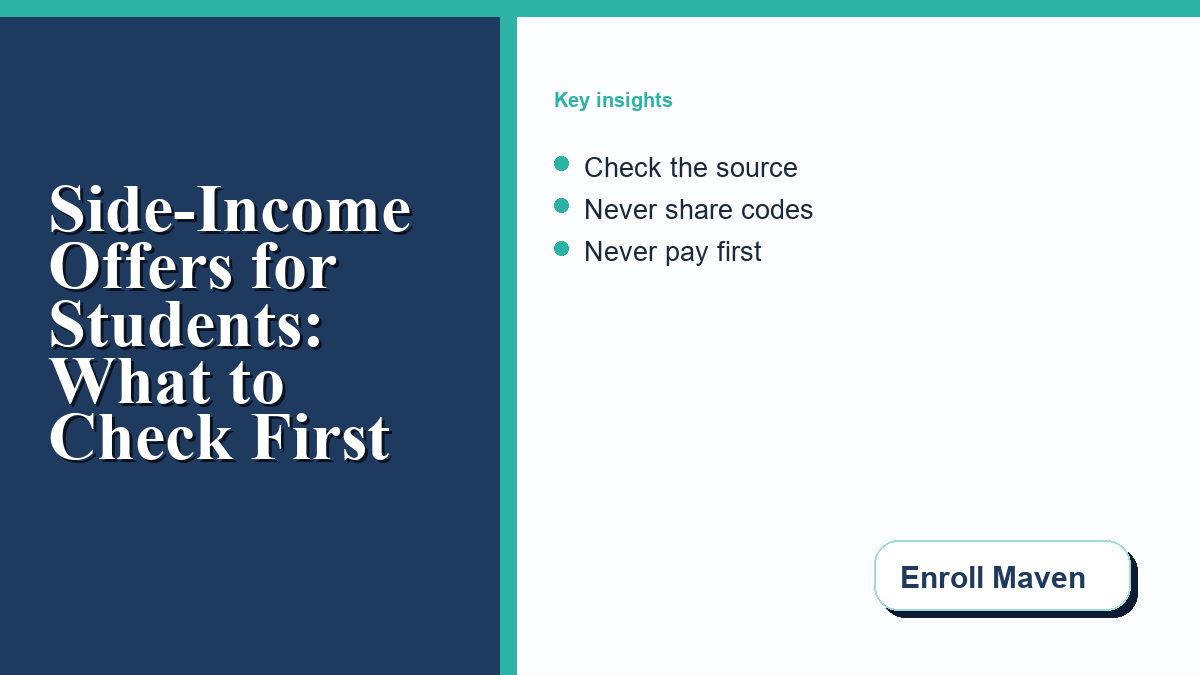
Side-Income Offers for Students: What to Check First
When an Allowance Does Not Stretch
Between transport, school projects, printing and lunch, a student allowance can run out before the week does. It is understandable that a message promising flexible online work looks appealing, especially when it says you can do it from your phone between classes. For students, and for the parents and guardians who advise them, the useful question is not whether every online offer is a trap, but what to check before any of them gets a reply, a payment or a personal detail.
If you are looking for a place to start, a student-focused guide to checking earning apps walks through the common risks one by one, including the ones that matter most for a younger reader. What follows is a shorter version for parents, guardians and students who want a few firm rules to keep in mind.
The First Rule: Nothing Is Paid Up Front
The European Consumer Centre Germany, a European consumer body whose guidance on job scams is general and not specific to the Philippines, states that no advance payment is required for legitimate jobs and that you should never pay money to receive a salary. For a student the rule is easy to apply and hard to argue with. If an app, a chat group or a recruiter asks for a deposit, a membership fee or a recharge before you can earn, the allowance you were trying to stretch is the thing at risk.
The same guidance lists other signs worth knowing: an offer that arrives without you applying for it, pay that sounds unrealistically high for little work, and no verifiable company information or contact person. Any one of those is a reason to pause. Together they are a reason to stop.
What Stays Private
GCash states in its safety guidance that you should never share your OTP, MPIN, passwords or screen during logins or transactions. That applies to students exactly as it applies to adults, including when the person asking says they are from a school program, a scholarship or an app support team.
Beyond those official rules, a sensible editorial suggestion is to keep your school ID, enrollment records and a selfie with your ID out of any chat group or app you cannot verify. A school ID carries personal details, and an unverified offer has no good reason to hold them. The European guidance adds that you should not give out personal information willingly.
Talking to the Adults Around You
Parents, guardians, older siblings and school counsellors are useful because they ask the questions a student may not think of when they are excited. Showing them the message, the website address and any written terms takes a few minutes. If an offer insists you keep it secret from the people who look after you, treat that as a warning sign. That is an editorial view, not a sourced rule, but an offer that cannot be shown to a trusted adult is not one to trust.
For parents, a calm conversation works better than a ban. Ask what the offer says the work is, who is behind it, and what it would cost. If the answers are vague, you have found your reason to say no together.
A Student’s Checklist Before Trying Anything
- Ask whether you applied for this, or whether it arrived unasked.
- Check that nothing has to be paid, deposited or recharged before you can earn.
- Look for a named company and a contact person outside the chat.
- Keep school ID, OTP, MPIN, passwords and your screen to yourself.
- Show the offer to a parent, guardian or counsellor before you decide.
- Keep dated screenshots of what the offer said.
Frequently Asked Questions
Should a student ever pay to join an earning group?
No. The European Consumer Centre Germany says no advance payment is required for legitimate jobs. If a group asks you to pay to join, activate an account or unlock tasks, stop and tell a trusted adult.
Is it safe to send a school ID to an app?
We would not. This is editorial advice rather than an official rule: do not send a school ID or an ID selfie to an app or chat group you cannot verify, because an unverified offer has no good reason to hold those details.
Where can a student report a suspicious offer?
GCash says suspected scams can be reported through its Help Center at help.gcash.com by chatting with Gigi and selecting the option to report a scam, or by calling 2882. If money was lost, the European guidance advises reporting to the police promptly.
This article provides general information and is not professional, legal or financial advice.


0 Comments